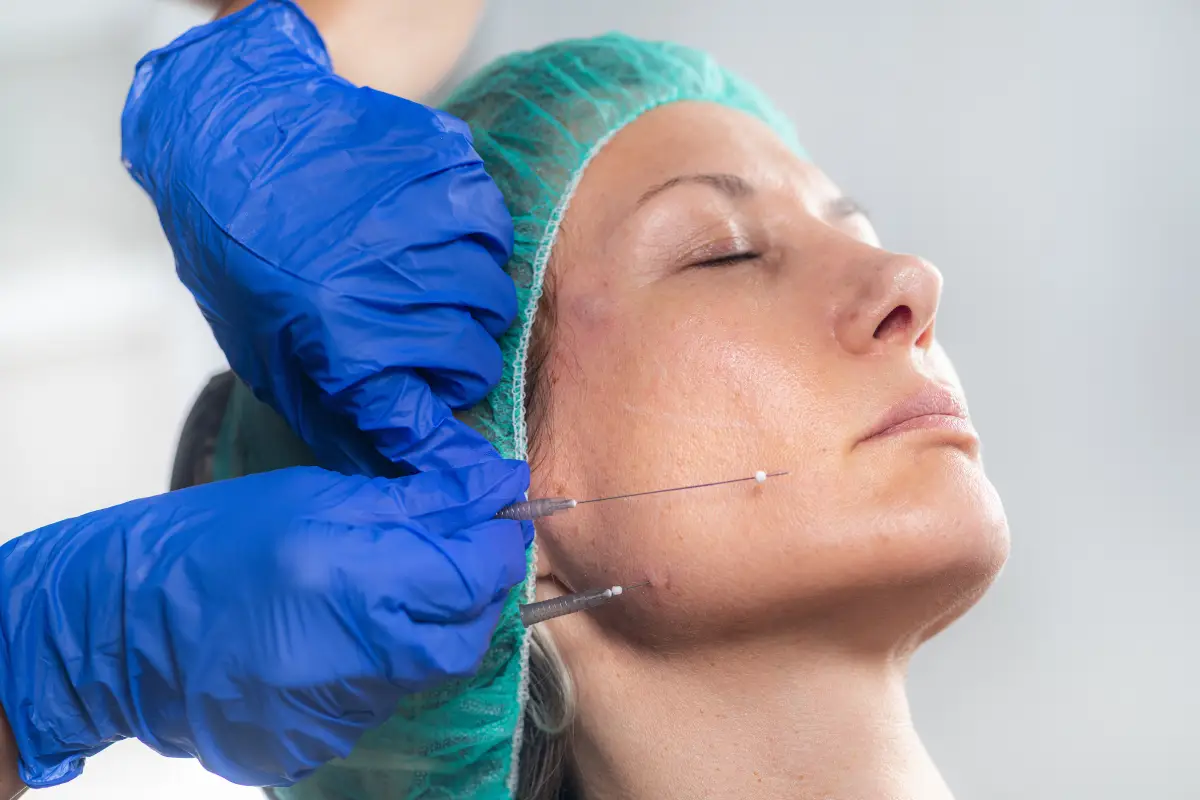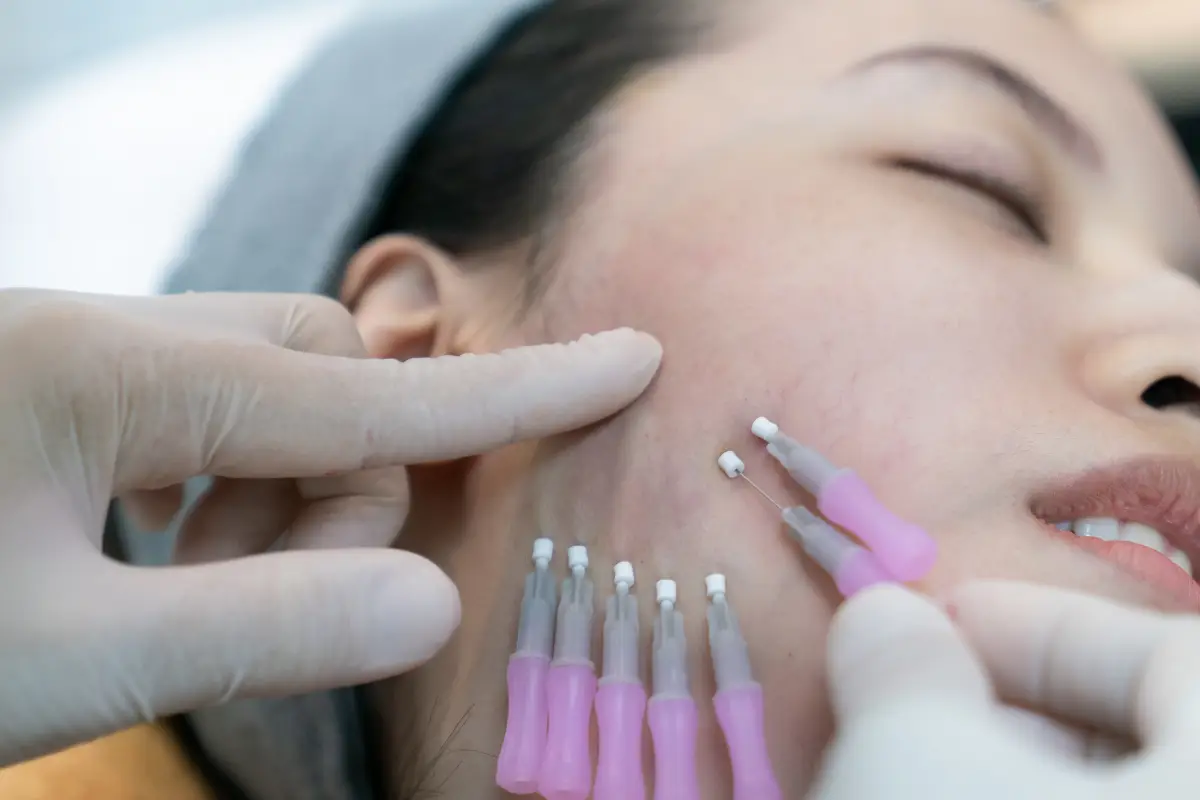

The 8 point facelift is one of the most searched non surgical treatments in Glasgow and one of the least well explained. It is not a machine, not a brand and not a product you can buy a box of. It is a way of placing dermal filler.
The short answer. An 8 point facelift is a technique in which hyaluronic acid filler is placed at eight paired points across the midface, cheeks, temples, tear trough area, nasolabial folds, marionette lines, jawline and chin, in an order chosen so that each placement supports the next. It restores volume and, through that, gives an impression of lift. At Luxe Skin by Dr Q in Glasgow this is priced as dermal filler work from GBP 350, not as a fixed package. It is the right treatment for a face that has lost volume. It is the wrong treatment for a face that has genuinely descended, and the difference between those two is the whole of this article.
This guide is written for people in and around Glasgow who have seen the phrase, are considering it, and want to know what it involves before they sit in a consultation room. It covers the eight points themselves, what filler can and cannot correct, what it costs, what happens on the day, what can go wrong, and when a different treatment is the better answer. It was written by the team at Luxe Skin, the clinic Dr Usman Qureshi runs at 227 Ingram Street in the city centre.
On this page
- What an 8 point facelift actually is
- The eight points, one at a time
- Volume loss and descent are not the same problem
- What it corrects well, and what it will not touch
- Who it suits, and who it does not
- What it costs in Glasgow
- 8 point facelift, Q Lift, thread lift or a full non surgical facelift
- What happens on the day
- Recovery, and what the first fortnight looks like
- What can go wrong, and how it is handled
- How long it lasts
- How this is approached at Luxe Skin
- Nine questions to ask before you book
- Frequently asked questions
What an 8 point facelift actually is
An 8 point facelift is a filler treatment carried out to a plan. The practitioner works through eight paired injection points on each side of the face, starting deep on the cheekbone and working down and outward, so that volume placed early carries the tissue below it.
The eight point idea came out of injector training in the early 2010s as a way of teaching a whole face approach rather than chasing one line at a time. That is its real value. Filling a nasolabial fold on its own is the classic beginner mistake, because the fold is usually a shadow cast by a cheek that has deflated above it. Treat the cheek and the fold softens without ever being injected.
So the number is a teaching device, not a prescription. Some faces need five points. Some need eleven. A practitioner who injects exactly eight on every patient is following a diagram rather than a face, and that shows up in the result. There is more on why structure has to lead in our facial anatomy guide.
The eight points, one at a time
The names vary between clinics. The territory does not. These are the eight, in the order they are usually approached, with what each one is actually doing.
| Point | Where it sits | What it is doing |
|---|---|---|
| 1. Lateral cheek | High on the cheekbone, towards the temple side | The anchor. Volume here supports everything below it and creates the ogee curve that reads as a lifted midface. |
| 2. Medial cheek | Front of the cheek, below the eye | Rebuilds the deep fat pad that flattens first. This is the point that softens a tear trough shadow without going near the tear trough. |
| 3. Temple | The hollow at the side of the forehead | Often skipped and often the reason a face still looks tired. A hollow temple narrows the upper face and makes the brow drop. |
| 4. Tear trough area | The groove between the lower lid and the cheek | The highest risk point on the face and the one most often overtreated. Frequently better left alone until the cheek above it has been rebuilt. |
| 5. Nasolabial fold | Nose to the corner of the mouth | Softened, rarely filled flat. A fold injected to nothing looks heavy in a smile. |
| 6. Marionette line | Corner of the mouth down towards the chin | Supports the corner of the mouth so it stops turning down at rest. Notoriously easy to overfill. |
| 7. Chin | Front and tip of the chin | Lengthens and projects. A short chin makes a jowl look worse than it is, so this point often changes the lower face more than the jawline point does. |
| 8. Jawline | Along the jaw from angle to chin | Redraws the line. Works when the skin still has some tension. Does very little when the skin has none. |
Notice how many of these entries carry a warning. That is deliberate. Every point on this list can be done badly, and the two that go wrong most often, the tear trough and the marionette line, are the two patients ask for by name. Our piece on marionette line filler going wrong covers what that actually looks like and what can be done about it.
Volume loss and descent are not the same problem
This is the section that decides whether the rest of the article applies to you.

A face ages in two ways at once. Fat pads deflate and bone resorbs, which is volume loss. Ligaments lengthen and tissue slides downward, which is descent. Filler is very good at the first and it cannot fix the second. Put volume into a face that has descended and you get a heavier face, not a lifted one. That is where the overfilled look comes from, and it is almost always a sequencing failure rather than a product failure.
A rough test you can do in a mirror. Lie back on a bed with your head off the edge so gravity pulls the tissue backwards, and look at your face in a hand mirror. If it looks like the face you remember, you have descent, and lifting is what you need. If it still looks flat and hollow, you have volume loss, and filler is the answer. Most faces over forty five have some of both, in a proportion that decides the plan.
The rule we work to. Restore volume where it is missing. Lift where tissue has moved. Never use one to imitate the other, because filler used as a lifting agent is the single most common cause of a face that looks treated.
What it corrects well, and what it will not touch
| Concern | Does an 8 point filler plan help? | What to consider instead |
|---|---|---|
| Flat or hollow cheeks | Yes. This is what the technique exists for. | Nothing else needed. |
| Hollow temples | Yes, and the effect on the upper face is often bigger than people expect. | Nothing else needed. |
| Nasolabial folds | Usually, indirectly, by rebuilding the cheek above them. | Direct filling only for the residual fold, if any. |
| Under eye shadow | Sometimes, and only after the cheek is addressed. | Careful assessment first. Some under eye shadow is pigment or skin quality, not hollowness. |
| Undefined jawline with good skin tone | Yes. | Jawline options compared. |
| Jowls with loose skin | No. Filler makes a heavy lower face heavier. | Q Lift or a non surgical facelift plan. |
| Loose neck skin | No. The neck is outside the eight points entirely. | Skin tightening or a surgical opinion. |
| Fine lines and crepey texture | No. Filler sits below the skin, not in it. | Morpheus8 from GBP 400, or laser resurfacing. |
| Expression lines across the forehead and around the eyes | No. Those are muscle, not volume. | Botox from GBP 195. |
| Pigmentation and sun damage | No. | Pigmentation treatment or resurfacing. |
Who it suits, and who it does not
We will take a position here, because a page that says every treatment suits everybody is not worth reading.
It suits you if
- You are roughly between 35 and 55 and the change you notice is flatness rather than sagging.
- Your skin still has tension when you pinch it at the cheek and it springs back quickly.
- You have been treating one feature at a time, usually the nasolabial folds, and the result never quite works.
- You want a change that is reversible. Hyaluronic acid filler can be dissolved, which is not true of a thread or of surgery.
- You can accept a result that is noticeable to you and not obvious to other people.
It does not suit you if
- Your main complaint is jowls, a sliding jawline or loose skin at the neck. Volume will make that worse, not better.
- You have had a lot of filler already and are not sure how much is in there. The first job is to work out what is present, and sometimes to dissolve it, before anything is added.
- You are hoping for the result of a facelift. It is not that treatment, and a quote that implies otherwise has misled you.
- You are pregnant or breastfeeding.
- You have an active skin infection or inflammatory condition in the treatment area.
- You want a permanent answer. Every hyaluronic acid filler is temporary by design, and for most people that is a feature rather than a drawback.
If you are in your late twenties or early thirties and reading this because of a photograph you did not like, please read our decade by decade guide first. Very few faces under thirty need volume, and the treatments that pay off at that age are skin quality treatments, not filler.
What it costs in Glasgow
Prices for an eight point plan in Glasgow vary more than almost any other treatment, because clinics are not pricing the same thing. Some quote per millilitre. Some quote a package. Some quote a headline figure that covers two syringes and then charge for the rest at the appointment.
At Luxe Skin, filler is priced as filler. Dermal fillers start at GBP 350, and what a full midface and lower face plan comes to depends on how many millilitres your face actually needs, which is decided at consultation and not on a price list. The price guide carries the current starting figures for every treatment in the clinic.
For comparison, and because these are the treatments people weigh an eight point plan against, the lifting procedures at the same clinic start considerably higher: the Q Lift from GBP 3,995, the non surgical facelift from GBP 3,995, and the Spring Thread Lift from GBP 3,995. That gap is the reason some people are quoted filler when they should have been quoted lift, and it is worth knowing about before you walk into any consultation.
What a fair quote looks like. A number of millilitres, a filler named, a price per millilitre or a total for that volume, and a stated plan for review. If a quote does not tell you how much product is going in, it is not a quote.
8 point facelift, Q Lift, thread lift or a full non surgical facelift

| Treatment | What it does | Best for | Downtime | From |
|---|---|---|---|---|
| 8 point filler plan | Restores volume at eight paired points so the midface supports the lower face | Flatness and hollowing with reasonable skin tension | Swelling and possible bruising for a few days | GBP 350 |
| Q Lift | Permanent spring threads placed through keyhole points to lift the face vertically | Descent: jowls, a dropping jawline, a lower face that has moved | About one week | GBP 3,995 |
| Spring Thread Lift | Threads under the skin to reposition sagging tissue | Moderate sagging where the skin still has some quality | Several days | GBP 3,995 |
| Non surgical facelift | A planned combination of filler, threads, radiofrequency tightening and injectables | Faces with volume loss and descent together, which is most faces after fifty | Depends on the combination | GBP 3,995 |
The summary, put plainly: filler is the cheapest entry point and the one most likely to be sold to somebody who needed something else. If your reflection has moved rather than flattened, the money is better spent once on a lift than repeatedly on volume that does not solve it. Our comparison of thread lifts against liquid lifts goes into that decision in more depth, and what actually works in a non surgical facelift covers the combination approach.
What happens on the day
- Assessment. Face at rest, then talking, then smiling. Photographs from three angles. What you dislike is recorded in your words, not translated into treatment names.
- The plan. Which points, in which order, how many millilitres and which filler. If part of the plan is a different treatment, that is said here rather than after your money has been taken.
- Consent and numbing. Risks explained, including the rare ones. Topical anaesthetic, and most modern fillers carry lidocaine as well.
- Injecting. Deep points first with a needle onto bone, superficial work usually with a blunt cannula. Roughly thirty to forty five minutes for a full plan.
- Review in the mirror. Sitting upright, not lying down. Faces look different under a treatment room light and lying flat.
- Aftercare and a review date. Two weeks is the usual point to judge a result, once swelling has gone.
Recovery, and what the first fortnight looks like
| When | What to expect |
|---|---|
| First 24 hours | Swelling, small red marks at entry points, occasional bruising. Sleep on your back and skip the gym. |
| Days 2 to 4 | Peak swelling for most people, usually in the cheeks and under the eyes. This is the stage that worries people and it settles. |
| Days 5 to 10 | Bruising fades. The face starts to look like the result rather than the treatment. |
| Two weeks | The point at which the result should be judged and reviewed. Filler has settled and integrated. |
| Four to six weeks | Any top up, if the plan called for one. Better done then than on the day. |
- Avoid alcohol for 24 hours and strenuous exercise for 48.
- No facials, massage, sauna or steam for two weeks.
- Do not press or massage the treated areas unless you have been told to.
- Paracetamol rather than ibuprofen or aspirin in the first day or two, since those thin the blood and worsen bruising.
- Arnica helps some people with bruising and is harmless if it does not.
What can go wrong, and how it is handled
Filler is a medical procedure. Most side effects are swelling and bruising and pass within a week. Two things matter enough to be written out plainly.
Vascular occlusion
Filler placed into or against a blood vessel can block it. It is rare and it is an emergency. The signs are immediate severe pain out of proportion to the injection, blanching or a white patch, a dusky or mottled look developing over hours, and in the case of vessels around the eye, any change in vision. If any of that happens, contact the clinic that treated you at once, or attend an emergency department if you cannot reach them. Speed is the whole of the treatment.
This is also the reason to ask a question that sounds blunt: does the clinic keep hyaluronidase, the enzyme that dissolves hyaluronic acid filler, on the premises. At Luxe Skin it is stocked on site, and Dr Q spent part of his career in emergency medicine before more than a decade in aesthetics.
The slower problems
- Overfilling. Usually gradual, usually the result of adding a little each visit without anyone standing back. It is reversible with hyaluronidase.
- Lumps and asymmetry. Common in the first fortnight and often just swelling. Judged at the two week review, not before.
- Migration. Filler moving from where it was placed, most often around the lips and tear trough, usually associated with too much product or too superficial a plane.
- A delayed nodule. Uncommon, sometimes triggered weeks or months later by an infection or a vaccination, and treatable. Report it rather than waiting to see.
How long it lasts
The dermal filler page at Luxe Skin gives six to twelve months as the working range, with results in some areas holding longer. That range is real and the variation inside it is mostly about movement and metabolism. Deep cheek and temple placement, where the tissue moves least, can hold well beyond a year. Marionette lines and the mouth area move constantly and go first.
People who keep a result looking consistent tend to come back for a smaller top up before it has fully gone, rather than starting again from flat every eighteen months. That is also cheaper over time. If you expect to be treated more than once or twice a year, the Q Plan membership is worth asking about at the consultation.
A note on product choice: not all filler behaves the same way, and a firm structural gel on a cheekbone is a different material from the soft gel used near the eye. Our comparison of filler types explains why the choice matters more than the brand name on the box.
How this is approached at Luxe Skin
Luxe Skin does not sell a product called an 8 point facelift, and that is a deliberate choice rather than an oversight. Selling a fixed number of points commits a clinic to injecting all eight whether or not your face needs all eight.
What happens instead is an assessment, then a filler plan built around what your face has actually lost, priced as dermal filler work from GBP 350. If the assessment finds descent rather than deflation, you will be told that, and the conversation moves to the Q Lift or a planned combination instead.
Dr Usman Qureshi has more than twenty years of medical experience including emergency medicine, more than twelve years in cosmetic practice, and has performed more than 20,000 procedures. The clinic is at 227 Ingram Street in Glasgow city centre, G1 1DA.
The number in the name is a teaching aid. The face in front of you is the brief.
If you want to know which of the two problems you actually have, that is a fifteen minute conversation and a mirror, not a sales pitch.
Nine questions to ask before you book
- Is my main problem volume loss or descent, and what did you look at to decide?
- How many millilitres are you planning, and of which filler?
- Which of the eight points are you not treating, and why?
- Who is injecting, and what is their medical qualification?
- Do you keep hyaluronidase on site?
- What is your plan if I have a vascular occlusion at nine o’clock on a Saturday night?
- What does the total cost cover, and what is charged separately?
- When do I come back to be reviewed, and is that included?
- What would you tell me not to have, if you were being blunt?
The last question is the most useful one on the list. A practitioner with nothing to say in answer to it is a practitioner who has not assessed you.
Key points to take away
- An 8 point facelift is a filler technique, not a product, and the number is a teaching device.
- It treats volume loss. It does not treat descent, and using it for descent is what creates a heavy, treated look.
- The cheek and the temple do most of the work. The nasolabial fold usually improves without being injected.
- At Luxe Skin it is priced as dermal filler from GBP 350 rather than as a package, because the millilitres depend on the face.
- If jowls or loose skin are your complaint, the Q Lift or a planned combination from GBP 3,995 is what we would recommend, even though it costs more.
- Ask whether hyaluronidase is kept on site before you let anyone inject you, anywhere.
Frequently asked questions
Is an 8 point facelift the same as a liquid facelift?
They overlap. Liquid facelift is the broader term for lifting the face with injectables, and it can include Botox and collagen stimulating products as well as hyaluronic acid filler. The 8 point facelift is one specific filler technique inside that category, defined by the eight paired placement points.
How much filler does an 8 point facelift need?
It depends entirely on how much volume has been lost. Some faces are treated properly with two to three millilitres across the midface. A face with significant deflation can need considerably more, staged across more than one appointment. Any clinic quoting a fixed volume before seeing you is quoting a package, not a plan.
Does it hurt?
Most people describe pressure rather than pain. Topical numbing cream is used and almost all modern fillers contain lidocaine. The deep points on the cheekbone are felt more than the superficial work. It is a thirty to forty five minute appointment, not a procedure you need to prepare for.
How soon can I go back to work?
Most people go back the same day or the next. What is visible afterwards is small red entry marks, some swelling and possibly a bruise. Plan around fourteen days before an event you care about, not two.
Can it be undone if I do not like it?
Yes, if hyaluronic acid filler was used, which it almost always is. Hyaluronidase dissolves it, usually within a day or two. That reversibility is one of the genuine advantages of filler over threads or surgery.
Will it help my jowls?
Usually not, and this is the single most important thing on this page. Jowls are descended tissue. Adding volume to a lower face that has already dropped makes it heavier. If jowls are your main concern, ask about the Q Lift or a non surgical facelift plan instead.
How much does an 8 point facelift cost in Glasgow?
At Luxe Skin, dermal filler treatment starts at GBP 350 and the total depends on how many millilitres your plan requires, agreed at consultation. Prices across Glasgow vary widely because clinics price differently, some per millilitre and some as a package, so compare what is included rather than the headline number.
How often would I need it repeated?
Results generally hold for six to twelve months, longer in the deep cheek and temple and shorter around the mouth. Most people who keep a steady result come back for a smaller top up once a year rather than starting from flat.
Glasgow city centre, 227 Ingram Street. If you would rather talk it through first, the clinic answers on 0141 573 1473.
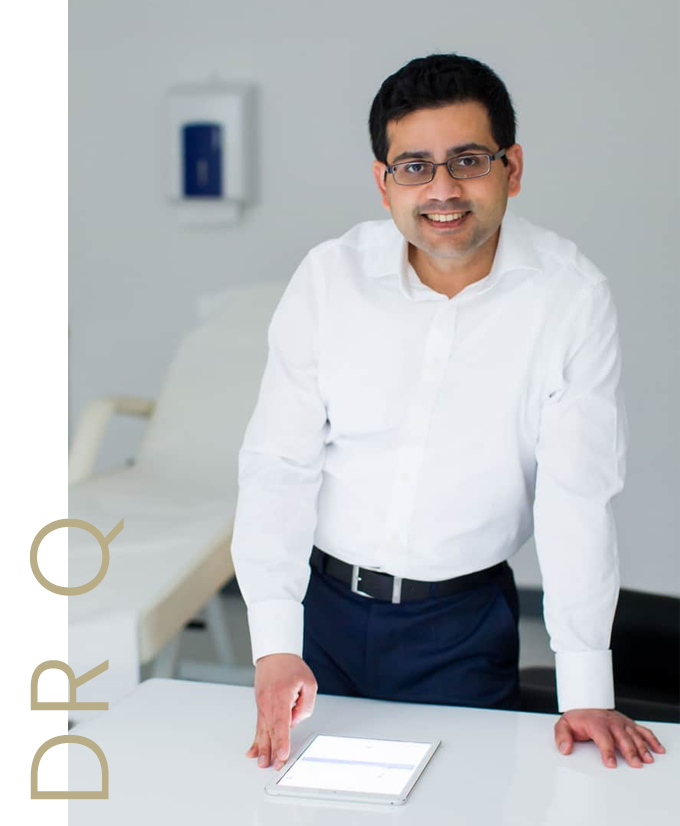
Dr Usman Qureshi (Dr Q) is a leading expert in aesthetic medicine with a 22 year career and a background spanning general practice, including A&E, and 12 years specialising in cosmetic procedures. A University of Glasgow graduate of 2002, he is the innovator behind the signature Q Lift, has performed over 20,000 procedures, and is an international speaker and trainer whose work has featured in Glamour and Harpers Bazaar.