Bra bulge is the fold of tissue that appears where a bra band or strap sits, most often at the side of the chest under the arm, and sometimes across the back. It is one of the most searched body concerns there is, and one of the most misunderstood, because people assume it is simply fat and then find that losing weight does not remove it.
The short answer. Bra bulge is usually a combination of four things, not one: fat sitting in the lateral chest and back, skin and connective tissue that has lost some firmness, the natural tail of breast tissue that extends towards the armpit, and compression from a bra that does not fit. Two of those four are free to address and worth trying first. The other two are structural, and they are what a clinic treatment is for.
What this guide covers
- What bra bulge actually is
- Why it appears in people who are not overweight
- The four things that create it
- Start with the bra, because it is free
- What exercise can and cannot change
- What does not work
- When it is worth seeing a clinic
- What Luxe Skin offers for the chest and back
- What treatment involves and what recovery looks like
- What it costs in Glasgow
- What results are realistic
- Questions worth asking
- Frequently asked questions
What bra bulge actually is
Bra bulge is a contour change, not a diagnosis. There is no medical condition by that name. What people are describing is soft tissue that sits proud of the surrounding surface at the point where a bra band or strap creates a line of compression, so the tissue on either side of that line looks fuller by contrast.
Two things follow from that. First, the bra itself is part of the picture, because the line it draws is what makes the fold visible. Second, the tissue creating the fold can be different things in different people, which is why identical advice produces very different results.
An older version of this article argued that bra bulge is fascia rather than fat. That was too absolute. Fascia and fibrous tethering are genuinely part of it for many people, and it does explain why fat reduction alone can disappoint, but the tissue at the bra line is usually a mixture and the proportions differ from person to person. Getting the proportions right for your body is the whole point of an assessment.
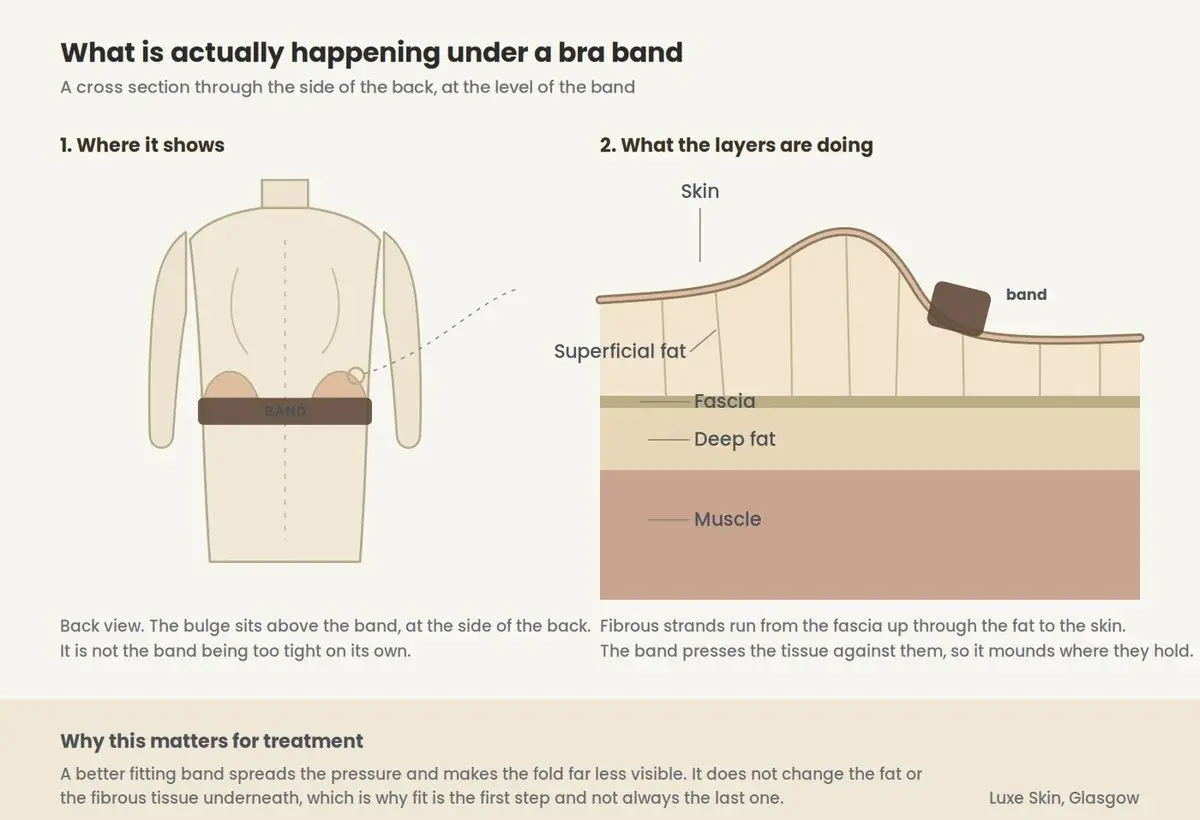
The diagram above is the whole argument in one picture. The band does not create tissue, it creates a line, and the tissue mounds on the side of that line where the fibrous strands running from the fascia to the skin hold the surface down. That is why two people carrying the same amount of fat can look completely different at the bra line, and why a treatment aimed only at fat can leave the contour unchanged.
Why it appears in people who are not overweight
This is the question that brings most people to the subject. Someone at a stable, healthy weight, who exercises, still sees a fold above the bra band. The reason is that three of the four contributors have nothing to do with body fat.
- The axillary tail. Breast tissue is not a neat hemisphere. It extends as a tail towards the armpit in most people, and in some that tail is prominent. It is normal anatomy, it is not fat, and it does not shrink with weight loss.
- Skin and connective tissue firmness. After pregnancy, after weight change, or simply with time, the skin and the supporting tissue underneath hold their shape less tightly. Softer tissue folds more readily over a firm band.
- Fibrous tethering. Bands of connective tissue anchor skin to the structures below at intervals. Where they are tight, the tissue between them can look bunched, in the same way that tethering creates the dimpling pattern people recognise elsewhere on the body.
- The bra. A band that is too tight, too loose, riding up at the back, or a strap set at the wrong width, will create or exaggerate a fold in tissue that would otherwise look flat.
If losing weight has not changed it, that is information rather than failure. It usually means the fold is coming from anatomy, tissue firmness or the bra, and those need a different approach.
Luxe Skin by Dr Q, Glasgow
The four things that create it
| Contributor | What it is | Does weight loss change it | What tends to address it |
|---|---|---|---|
| Lateral chest and back fat | Fat deposited at the side of the chest and across the back | Sometimes, and often last | Fat reduction, surgical or minimally invasive |
| Skin and tissue laxity | Reduced firmness in skin and the tissue beneath it | No, and it can look worse after weight loss | Tightening, or a treatment that reduces fat and tightens together |
| Axillary tail of breast tissue | Normal breast tissue extending towards the armpit | No | Nothing non surgical. Assessment matters, because this is breast tissue |
| Bra fit and strap position | Compression drawing a line across the tissue | Not relevant | A correct band size and strap width, professionally fitted |
A note worth taking seriously. Any new, firm or one sided lump in the chest, armpit or breast area is not something to put down to bra bulge. Contour concerns are symmetrical and gradual. A new lump on one side, skin dimpling that appeared recently, or any change to the nipple should be seen by your GP, not by an aesthetic clinic. The NHS guidance on breast lumps sets out what to look for. This article is about appearance, and appearance concerns should only be treated once anything medical has been ruled out.
Start with the bra, because it is free
A large share of what people describe as bra bulge is a fit problem, and it costs nothing to rule out. Most of the support in a bra comes from the band rather than the straps, and a band that is too big rides up at the back and tightens at the sides to compensate, which is exactly how you create a fold.
- Get measured properly, and get measured again after any weight change or pregnancy. Most people are wearing a band that is too large and a cup that is too small, which is the combination that produces spillage at the side.
- Check the band at the back. It should sit level, in a straight line, and stay there when you raise your arms. If it rides up, it is too big.
- Two fingers under the band, not one and not four. Firm and level, not gripping.
- Look at strap width and placement. Wider straps set further apart distribute pressure and cut in less.
- Check the cup depth at the side. A cup that stops too soon pushes the axillary tail outwards and creates the fold under the arm. A full cup style with side support often removes the appearance entirely.
- Judge it in a fitted top, in a mirror, from the side. Not straight on. The fold is a side profile problem and it is invisible from the front.
If a properly fitted bra removes the fold, you have your answer and you do not need a treatment. If the tissue is still there when nothing is compressing it, the contour is structural and that is a different conversation.
What exercise can and cannot change
Exercise is worth doing and it will help, but it helps for reasons that are often misunderstood.
- It cannot reduce fat from one area. Targeted fat loss is not how the body works. Training the back does not remove fat from the back specifically, and any programme that claims otherwise is selling something.
- It can change the shape underneath. Building the muscles across the upper back and shoulders alters the surface those tissues sit on, and better posture through the thoracic spine changes how the bra sits and how the tissue falls.
- It can reduce overall body fat. Which will reduce the fat component, though usually later than in other areas, and it will not touch the other three contributors at all.
Give any change of routine a proper stretch of months before judging it, and photograph yourself from the side in the same light at the start and again later. Memory is a poor comparator.
What does not work
- Firming creams. Nothing applied to the surface reaches or reorganises the tissue causing the fold.
- Body wraps and lymphatic wraps sold as fat removal. Any change is fluid and it returns.
- Compression garments as a permanent answer. They redistribute while worn, which is fine as a garment choice and is not a treatment.
- Weight loss alone, in the wrong person. If the fold is laxity, tethering or the axillary tail, losing weight can make the appearance worse rather than better, because less volume under looser skin folds more easily.
- Treating it before anything medical has been checked. Covered above, and it is the one that matters most.
When it is worth seeing a clinic
A consultation is worth the time if you have already ruled out the free explanations and the tissue is still there. In practice that means:
- You have been professionally fitted for a bra and the fold is still visible with the bra off.
- Your weight has been stable for a reasonable period and the area has not changed with it.
- The concern is symmetrical and long standing rather than new on one side.
- It affects what you are willing to wear, which is a legitimate reason to look at it.
What you should expect from the consultation is an assessment of which of the four contributors is dominant in your case, and a clear answer about what a treatment can and cannot change. Dr Usman Qureshi consults at Luxe Skin in Glasgow city centre.
What Luxe Skin offers for the chest and back
The body treatments at Luxe Skin address fat deposits, skin laxity and contour changes, and the body page names the chest and back among the areas where fullness and sagging develop. Two listed treatments are relevant here, and which one suits depends entirely on the mixture in your tissue.
BodyTite, radiofrequency assisted contouring
BodyTite is minimally invasive and works through tiny entry points. It uses controlled radiofrequency energy to reduce fat and tighten the skin at the same time, and it stimulates collagen for continued firming afterwards. That combination is the reason it is relevant to a bra line concern: where the fold is part fat and part laxity, removing the fat alone can leave the skin looser than it was. It is listed from £4,995.
Liposuction
liposuction removes fat deposits directly and is the more appropriate route where fat is clearly the dominant component and skin quality is good. It is listed from £4,995. It is worth saying plainly that liposuction is a contouring procedure and not a weight loss tool, a point covered in our article on the strategic use case for liposuction.
Dr Usman Qureshi has more than twenty years of medical experience, more than twelve years as a cosmetic doctor, over 20,000 aesthetic procedures completed and specialist training in BodyTite, AccuTite, radiofrequency liposuction and skin tightening. For an area where fat and skin quality both matter, that combination of training is the relevant part.
What we will not claim. If your fold is largely the axillary tail of breast tissue, no body contouring treatment on this list is the answer, and the appropriate route is a proper assessment rather than a booking. A clinic that promises to remove it with a fat treatment has not examined you.
What treatment involves and what recovery looks like
Both procedures are performed by the doctor, and the details of your own plan, including anaesthesia, entry points and aftercare, are set at consultation. The shape of recovery is broadly consistent.
- Assessment and planning. The area is examined and marked, the dominant contributor identified, and the realistic outcome described before anything is agreed.
- The procedure. Minimally invasive, through small entry points, as a day case.
- Compression. A garment is usually worn for a period afterwards, and wearing it as instructed materially affects the result.
- Swelling and settling. Swelling and bruising are expected early on. The area continues to refine over weeks, and the tightening effect from radiofrequency builds over months as collagen forms.
- Review. Compared against photographs taken before, in the same light and the same position.
Judging the outcome at two weeks is the commonest mistake people make. Contour work is assessed at three months and again later.
What it costs in Glasgow
The published starting figures on the Luxe Skin price guide are £4,995 for BodyTite and £4,995 for liposuction. Those are from prices. What your own treatment costs depends on the area treated, the extent of the work and whether tightening is needed alongside fat reduction, and it is quoted after assessment rather than over the phone.
When comparing quotes, check what is included: the consultation, the procedure, the compression garment, follow up appointments and any review. A headline figure that excludes aftercare is not the number you will pay.
What results are realistic
A well judged treatment softens or removes the fold in profile and improves how clothing sits. It does not change the underlying anatomy of the breast, and it does not make an ill fitting bra fit.
The people who are happiest afterwards are the ones who were told clearly beforehand which part of their concern was going to change and which part was not. If nobody has said that to you, ask.
The short version
- Bra bulge is a contour, not a condition, and it is usually a mixture of fat, tissue laxity, the natural tail of breast tissue and bra fit.
- Get professionally fitted first. It is free, and for a lot of people it is the whole answer.
- Exercise helps by changing the shape underneath and reducing overall fat. It cannot remove fat from one area.
- Creams, wraps and compression garments do not change the tissue.
- Where fat and laxity are both involved, BodyTite reduces fat and tightens together, from GBP 4,995. Where fat dominates and skin quality is good, liposuction is listed from GBP 4,995.
- Anything new, firm or one sided goes to your GP first, not to an aesthetic clinic.
Questions worth asking
- Which of the four contributors is dominant in my case, and how did you decide that?
- How much of this will change, and how much is anatomy that will not?
- Do I need tightening as well as fat reduction, or would fat reduction alone leave the skin looser?
- Who performs the procedure, and what is their specific training on this device?
- What does recovery look like in days, and how long is the compression garment worn?
- What is the total cost including consultation, garment and follow up?
- When will we review it, and will the photographs be taken in the same light and position?
- What happens if the result is less than we hoped?
Frequently asked questions
What is bra bulge?
Bra bulge is the fold of tissue that appears where a bra band or strap presses, most often at the side of the chest near the armpit and sometimes across the back. It is a contour change rather than a medical condition, and it is usually created by a combination of fat, reduced skin and tissue firmness, the natural tail of breast tissue extending towards the armpit, and compression from a bra that does not fit correctly.
Is bra bulge fat?
Partly, in many people, but rarely only fat. Fat sitting in the lateral chest and back is one contributor. The others are skin and connective tissue that has lost firmness, fibrous tethering, and the axillary tail of breast tissue, none of which reduce with weight loss. That mixture is why some people lose weight and see no change at the bra line.
What causes bra bulge?
Four things, usually in combination: fat deposited at the side of the chest and across the back, reduced firmness in skin and the tissue beneath it after pregnancy, weight change or time, the natural tail of breast tissue that extends towards the armpit, and a bra whose band or cup does not fit, which draws a line of compression across otherwise normal tissue.
Why do I have bra bulge when I am slim?
Because three of the four contributors have nothing to do with body fat. The axillary tail of breast tissue is normal anatomy and does not shrink. Skin and tissue firmness is independent of weight and can look worse after weight loss. Bra fit affects everyone regardless of size. A properly fitted bra removes the appearance for a good number of people.
Can exercise get rid of bra bulge?
Exercise cannot remove fat from one specific area, because targeted fat loss is not how the body works. It does help in two other ways: building the muscles of the upper back and shoulders changes the surface the tissue sits on, and reducing overall body fat will reduce the fat component eventually. It will not change tissue laxity or breast anatomy.
Do creams or wraps work on bra bulge?
No. Nothing applied to the surface reaches the tissue that creates the fold. Wraps that appear to work are moving fluid, and the effect returns within days. Compression garments change the appearance while worn, which makes them a reasonable clothing choice and not a treatment.
What treatment removes bra bulge?
Where the fold is a mixture of fat and skin laxity, a treatment that addresses both is usually the right answer. At Luxe Skin in Glasgow, BodyTite uses radiofrequency to reduce fat and tighten skin at the same time and is listed from GBP 4,995. Where fat clearly dominates and skin quality is good, liposuction is listed from GBP 4,995. Which one suits is decided at assessment.
When should I see a doctor rather than a clinic?
Any new lump, a change that has appeared on one side only, recent skin dimpling or any change to the nipple should be assessed by your GP first. Contour concerns are symmetrical and develop gradually. Nothing cosmetic should be planned until anything medical has been ruled out.
Talk to Dr Q about the bra line
If a properly fitted bra has not solved it and your weight has been stable, an assessment will tell you which part of the fold can change. Luxe Skin by Dr Q, 227 Ingram Street, Glasgow G1 1DA. Call 0141 573 1473, message 07538 304839 or email info@luxeskin.co.uk.
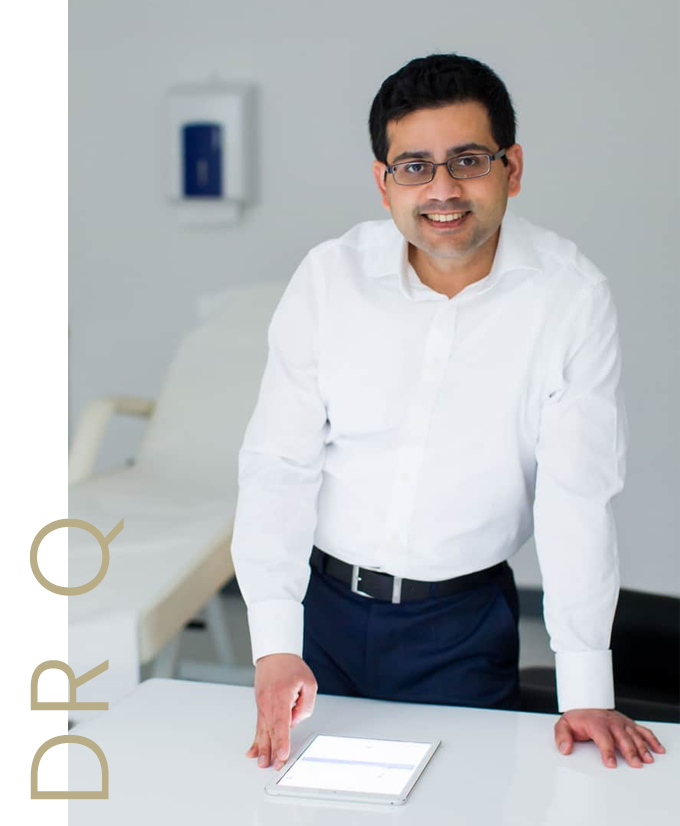
Dr Usman Qureshi (Dr Q) is a leading expert in aesthetic medicine with a 22 year career and a background spanning general practice, including A&E, and 12 years specialising in cosmetic procedures. A University of Glasgow graduate of 2002, he is the innovator behind the signature Q Lift, has performed over 20,000 procedures, and is an international speaker and trainer whose work has featured in Glamour and Harpers Bazaar.